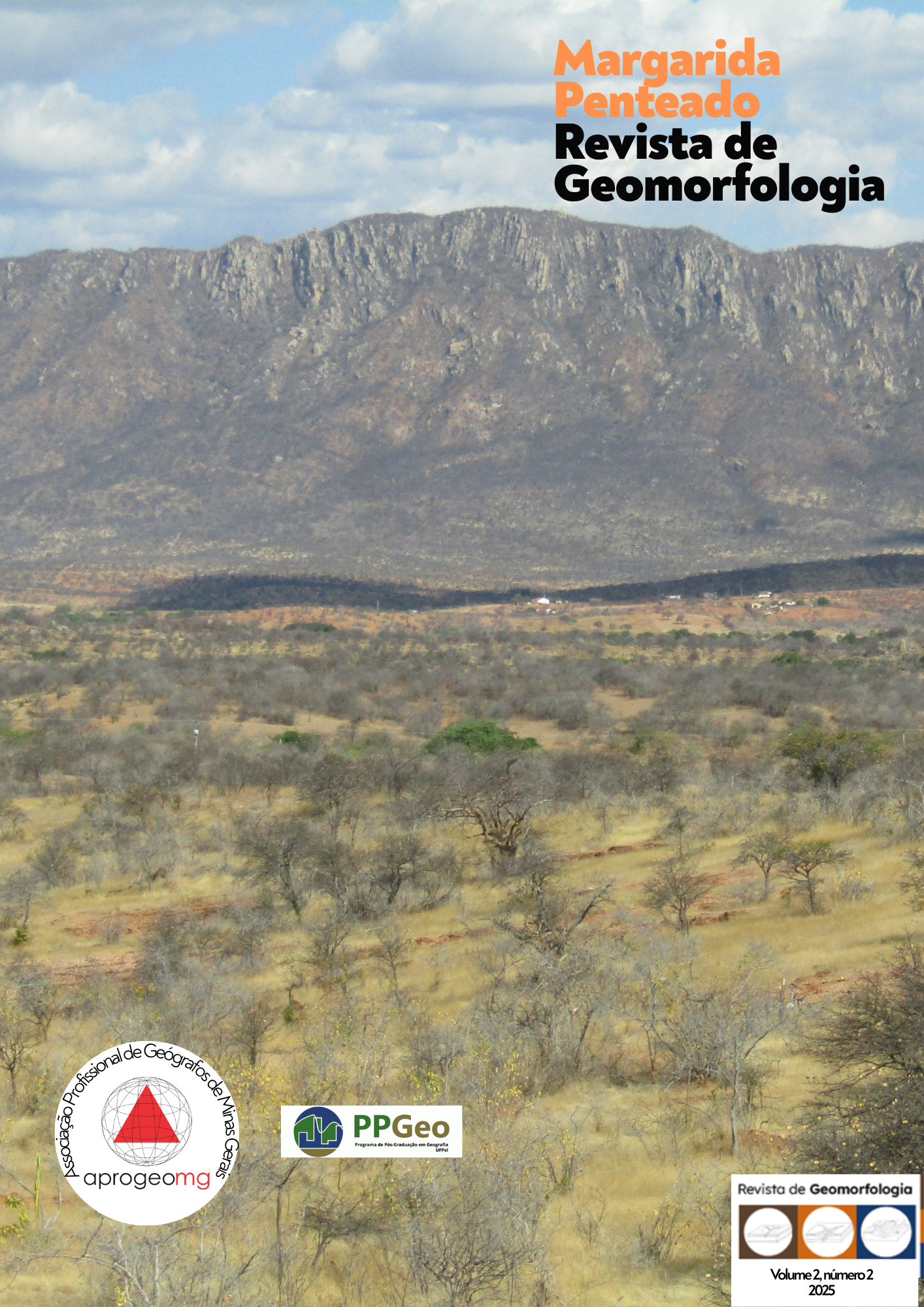
QUATERNARY COLLUVIAL DEPOSITS AS GEOARCHIVES OF THE SOIL–LANDSCAPE RELATIONSHIP IN THE SEMI-ARID REGION: EVIDENCE FROM THE SERRA DA TAQUARA MASSIF (PE), BRAZIL / SEDIMENTOS COLUVIAIS QUATERNÁRIOS COMO GEOARQUIVOS DA RELAÇÃO SOLO–PAISAGEM NO SEMIÁRIDO: EVIDÊNCIAS DO MACIÇO DA SERRA DA TAQUARA (PE), BRASIL
DOI:
https://doi.org/10.66049/Palavras-chave:
Colúvio ; Geoarquivos; SemiáridoResumo
Os depósitos coluviais quaternários do Maciço da Serra da Taquara (PE/Brasil) foram investigados como geoarquivos
da relação solo–paisagem em ambiente semiárido. O estudo objetivou avaliar a dinâmica pedosedimentar e o
intemperismo químico por meio de análises granulométricas e geoquímicas em quatro perfis coluviais distribuídos ao
longo de uma topossequência. Foram aplicadas granulometria a laser, fluorescência de raios X e o Índice Químico de
Alteração (Chemical Index of Alteration – CIA). Os resultados evidenciaram forte controle morfotopográfico sobre a
evolução geoquímica, com maior intensidade de intemperismo nos setores mais estáveis da vertente. Os depósitos
registram retrabalhamento sedimentar, estabilidade pedogenética e oscilações paleoambientais quaternárias,
confirmando o potencial dos colúvios como geoarquivos estratégicos da evolução morfopedológica do semiárido
brasileiro.
Referências
AB’SÁBER, A. N. O relevo brasileiro e seus problemas. In: AZEVEDO, A. (org.). Brasil, a terra e o homem. São Paulo: Nacional Companhia Editora, 1964. p. 135–250.
AB’SÁBER, A. N. Os domínios de natureza no Brasil: potencialidades paisagísticas. São Paulo: Ateliê Editorial, 2003.
ANDERSON, S. P. et al. Exploring weathering and regolith transport controls on Critical Zone development with models and natural experiments. Applied Geochemistry, v. 26, p. S3–S5, 2011. https://doi.org/10.1016/j.apgeochem.2011.03.004
AYOADE, J. O. Introduction to climatology for the tropics. London: John Wiley & Sons, 1983.
BIGARELLA, J. J.; MOUSINHO, M. R.; SILVA, J. X. Estrutura e origem das paisagens tropicais e subtropicais. Florianópolis: UFSC, 1994.
BLAIR, T. C.; MCPHERSON, J. G. Processes and forms of alluvial fans. In: PARSONS, A. J.; ABRAHAMS, A. D. (org.). Geomorphology of desert environments. 2. ed. Dordrecht: Springer, 2009. p. 413–467.
BRANTLEY, S. L. et al. Toward a conceptual model for the evolution of the critical zone. Applied Geochemistry, v. 22, p. 210–213, 2007. https://doi.org/10.1016/j.apgeochem.2006.10.006
BRANTLEY, S. L.; LEBEDEVA, M. Geochemical weathering and critical zone evolution. Reviews in Mineralogy and Geochemistry, v. 85, p. 45–72, 2011.
BRITO NEVES, B. B. et al. Tectonic evolution of the Borborema Province. Journal of South American Earth Sciences, v. 14, p. 251–262, 2001. https://doi.org/10.1016/S0895-9811(01)00016-1
BROVKIN, V. et al. Past and future changes in land carbon storage. Nature Geoscience, v. 12, p. 424–429, 2019. https://doi.org/10.1038/s41561-019-0354-4
BURBANK, D. W.; ANDERSON, R. S. Tectonic geomorphology. 2. ed. Oxford: Wiley‑Blackwell, 2012.
CARSON, M. A.; KIRKBY, M. J. Hillslope form and process. Cambridge: Cambridge University Press, 1972.
CARSON, M. A.; KIRKBY, M. J. Hillslope form and process. Cambridge: Cambridge University Press, 1972.
CHADWICK, O. A. et al. From a black box to a gray box: a mass balance interpretation of pedogenesis. Geomorphology, v. 3, p. 369–390, 1990.
CHO, S. J. et al. Sediment sources and connectivity linked to hydrologic processes. Frontiers in Water, v. 5, 2023. https://doi.org/10.3389/frwa.2023.1241622
CORRÊA, A. C. B. et al. Geomorphological evolution of semi‑arid landscapes in northeastern Brazil. Geomorphology, v. 118, p. 1–12, 2010. https://doi.org/10.1016/j.geomorph.2009.12.012
CORRÊA, A. C. B. Geomorfologia do semiárido nordestino. Recife: UFPE, 2001.
D’ARCY, M.; RITCHIE, A.; MACKLIN, M. G. Floodplain sediment storage and sediment connectivity in dryland environments. Earth Surface Processes and Landforms, v. 42, n. 2, p. 190–205, 2017. https://doi.org/10.1002/esp.4063
DIETRICH, W. E.; PERRON, J. T. The search for a topographic signature of life. Nature, v. 439, p. 411–418, 2006. https://doi.org/10.1038/nature04452
DIXON, J. L. et al. The role of climate and lithology in controlling soil production. Nature Geoscience, v. 9, p. 348–351, 2016. https://doi.org/10.1038/ngeo2699
FOLK, R. L.; WARD, W. C. Brazos River bar: a study in the significance of grain‑size parameters. Journal of Sedimentary Petrology, v. 27, p. 3–26, 1957.
FONSECA, D. N. et al. Climatically driven Quaternary sedimentation in a passive margin tropical context. Geomorphology, v. 461, 2024. https://doi.org/10.1016/j.geomorph.2024.109316
FONSECA, D. N. et al. Coupling of tectonic factors and precipitation variability as a driver of Late Quaternary aggradation in Northeast Brazil. Earth Surface Processes and Landforms, v. 45, n. 14, p. 3485–3503, 2020. https://doi.org/10.1002/esp.4982
GALE, S. J.; HOARE, P. G. Quaternary sediments: petrographic methods for the study of unlithified rocks. London: Belhaven Press, 1991.
GILBERT, G. K. Report on the geology of the Henry Mountains. Washington: U.S. Government Printing Office, 1877.
GOIS, L. S. S. et al. Caracterização sedimentológica dos colúvios do Maciço de Mata Grande. Revista de Geociências do Nordeste, v. 7, n. 1, 2021. https://doi.org/10.21680/2447-3359.2021v7n01
GOLDBERG, K. M.; HUMAYUN, M. Geochemical constraints on weathering and sediment provenance. Chemical Geology, v. 524, p. 112–126, 2019. https://doi.org/10.1016/j.chemgeo.2019.05.015
GOOD, S. P.; NOONE, D.; BOWEN, G. J. Hydrologic connectivity constrains partitioning of global terrestrial water fluxes. Science, v. 349, n. 6244, p. 175–177, 2015. https://doi.org/10.1126/science.aab1665
GOUDIE, A. Geomorphological processes in the tropical environment. London: Routledge, 2013.
HARVEY, A. M. Dryland alluvial fans and climatic change. Geomorphology, v. 139‑140, p. 222–237, 2012. https://doi.org/10.1016/j.geomorph.2011.10.017
HEIMSATH, A. M. et al. Soil production and transport in landscapes. Annual Review of Earth and Planetary Sciences, v. 40, p. 255–283, 2012. https://doi.org/10.1146/annurev-earth-042711-105012
HENKNER, J. et al. Archaeopedological analysis of colluvial deposits. Royal Society Open Science, v. 5, p. 171624, 2018. https://doi.org/10.1098/rsos.171624
HOWARD, A. D. A detachment‑limited model of drainage basin evolution. Water Resources Research, v. 30, p. 2261–2285, 1994. https://doi.org/10.1029/94WR00757
HUGGETT, R. J. Fundamentals of geomorphology. 4. ed. London: Routledge, 2017.
KAPPLER, C. et al. Stratigraphy and age of colluvial deposits indicating Late Holocene soil erosion. Catena, v. 170, p. 224–245, 2018. https://doi.org/10.1016/j.catena.2018.06.010
LIMA, F. J. et al. Late Quaternary geomorphological evolutionary dynamics of the Araripe Plateau. Journal of South American Earth Sciences, v. 124, 2023. https://doi.org/10.1016/j.jsames.2023.104244
LIRA, D. R. Evolução geomorfológica e paleoambiental das bacias do Riacho do Pontal e GI‑8. Tese (Doutorado) – Universidade Federal de Pernambuco, Recife, 2014.
MCLENNAN, S. M. Weathering and global denudation. Journal of Geology, v. 101, p. 295–303, 1993. https://doi.org/10.1086/648222
MIGOŃ, P. Granite landscapes of the world. Oxford: Oxford University Press, 2006.
MIGOŃ, P. Landscapes and landforms of Brazil. Cham: Springer, 2019. https://doi.org/10.1007/978-3-319-73774-3
MONTEIRO, C. A. F. A dinâmica climática e as chuvas no estado de São Paulo. São Paulo: USP, 1973.
NESBITT, H. W.; YOUNG, G. M. Early Proterozoic climates and plate motions inferred from major element chemistry of lutites. Nature, v. 299, p. 715–717, 1982. https://doi.org/10.1038/299715a0
PAISANI, J. C. et al. Pleistocene–Holocene colluvial facies from the volcanic plateau of the Paraná Sedimentary Basin (Brazil). Journal of South American Earth Sciences, v. 126, 2023. https://doi.org/10.1016/j.jsames.2023.104344
PEJRUP, M. The triangular diagram used for classification of estuarine sediments. In: DE BOER, P. L.; VAN GELDER, A.; NIO, S. D. (ed.). Tide‑influenced sedimentary environments and facies. Dordrecht: Reidel, 1988.
RETALLACK, G. J. Soils of the past: an introduction to paleopedology. 2. ed. Oxford: Blackwell, 2001.
SACO, P. M.; WILLGOOSE, G. R.; HANCOCK, G. R. Eco-geomorphology of banded vegetation patterns in arid and semi-arid regions. Hydrology and Earth System Sciences, v. 17, p. 1685–1700, 2013.
SCHUMM, S. A. The fluvial system. New York: John Wiley & Sons, 1977.
SELBY, M. J. Earth’s changing surface. Oxford: Oxford University Press, 1985.
SHELDON, N. D.; TABOR, N. J. Quantitative paleoenvironmental and paleoclimatic reconstruction using paleosols. Earth‑Science Reviews, v. 95, p. 1–52, 2009. https://doi.org/10.1016/j.earscirev.2009.03.004
SHEPARD, F. P. Nomenclature based on sand‑silt‑clay ratios. Journal of Sedimentary Petrology, v. 24, p. 151–158, 1954. https://doi.org/10.1306/D4269774-2B26-11D7-8648000102C1865D
STALLARD, R. F.; EDMOND, J. M. Geochemistry of the Amazon River: the influence of geology and weathering environment on the dissolved load. Journal of Geophysical Research, v. 88, p. 9671–9688, 1983.
THOMAS, M. F. Tropical geomorphology. Progress in Physical Geography, v. 35, p. 463–482, 2011.
TRICART, J. Ecodinâmica. Rio de Janeiro: IBGE/SUPREN, 1977.
TRICART, J.; CAILLEUX, A. Introduction à la géomorphologie climatique. Paris: SEDES, 1972.
TUCKER, G. E.; SLINGERLAND, R. Drainage basin responses to climate change. Water Resources Research, v. 33, p. 2031–2047, 1997. https://doi.org/10.1029/97WR00409
WENTWORTH, C. K. A scale of grade and class terms for clastic sediments. Journal of Geology, v. 30, p. 377–392, 1922. https://doi.org/10.1086/622910
WEST, A. J.; GALY, A.; BICKLE, M. Tectonic and climatic controls on silicate weathering. Earth and Planetary Science Letters, v. 235, p. 211–228, 2005. https://doi.org/10.1016/j.epsl.2005.03.020